If you live here
You join one of the three schemes of the Protection Sociale Généralisée, created in 1995 and run by the CPS. Coverage reaches 98 % of the population. Standard reimbursement is 70 %.
Living here · written from Raiatea
Residents use the local CPS system. Visitors—including US travelers—must rely on their own coverage, and the European Health Insurance Card is not valid here. Check hospital, inter-island evacuation and international repatriation limits before departure.
The short answer
You join one of the three schemes of the Protection Sociale Généralisée, created in 1995 and run by the CPS. Coverage reaches 98 % of the population. Standard reimbursement is 70 %.
Form SE 980-04, obtained from your fund before you leave, covers immediately necessary care only. In a town practice you pay first and claim later.
You pay the published hospital tariff. A day in intensive care at the territorial hospital is billed at 820 000 XPF (about €6,870 or $7,900 at the September 18, 2026 ECB reference rate).
No public scheme repatriates a visitor. The cost of an uncovered international medical evacuation is not published anywhere — which is precisely the risk an insurance policy exists to absorb.
The system
The Caisse de Prévoyance Sociale (CPS) collects contributions and pays benefits for the whole country. Which scheme you fall into is not a choice; it follows from your situation.
| Scheme | Who it covers | Share of members |
|---|---|---|
| RGS — general salaried scheme | Anyone in salaried employment; the employer registers you | about 60 % |
| RNS — self-employed scheme | Independents and patentés above the RSPF income ceilings | about 6 % |
| RSPF — solidarity scheme | Compulsory after 6 months' residence below 87 346 XPF a month (single) or 97 346 XPF (couple or single parent) | about 25 % |
Employees have their rights opened by their employer, on condition of 80 hours of salaried work a month or pay at least equal to the SMIG. Dependants covered are the spouse, PACS partner or cohabiting partner (with an annual certificate), and children under 16, under 18 in apprenticeship, under 21 in full-time study.
Agents of the French State posted here stay on metropolitan social security and do not switch to the CPS. A convention allows direct billing on presentation of a valid entitlement certificate and a form of the 980 series. Staff recruited locally on local contracts do fall under the CPS.
What comes back
The standard rate is 70 % of the caisse's reference tariff; the remaining 30 % is the patient's share. Medicines are reimbursed between 30 and 70 % depending on the product. Hospitalisation, sick leave beyond 30 days, pregnancy and related procedures, contraception and medical evacuation are covered at 100 %. Going outside the coordinated care pathway, or having no declared family doctor, increases the patient's share.
The local term for long-term conditions is longue maladie, not the metropolitan "ALD". Once granted by the medical officer, it pays 95 % of the reference tariff for related consultations and 100 % of all prescribed medicines, with daily allowances for up to three years from the 31st day of sick leave.
Direct billing is not general. It applies in specific cases — hospitalisation, longue maladie, appliances. Otherwise you pay and claim.
Coming from France or Europe
French Polynesia is an Overseas Country and Territory. EU coordination regulations do not apply to it, and it runs its own social security system. The relationship with the French system is not an extension but a coordination decree — n° 94-1146 of 26 December 1994, in force since 1 January 1995.
The European Health Insurance Card is not valid in French Polynesia. It works only within the scope of the EU regulations: the 27 member states, Norway, Iceland, Liechtenstein, Switzerland and the United Kingdom. French Polynesia is in none of those.
What a French insured person needs instead is form SE 980-04, obtained from their own fund before departure. Article 18 of the decree opens a right to immediately necessary care — not planned treatment, and neither repatriation nor assistance. In practice: at a town practice you advance the fee and claim afterwards; at a hospital the form allows direct billing, and you settle only the usual patient share.
Where the care is
The Centre hospitalier de la Polynésie française, at Taaone in Pirae, opened on 25 October 2010 and is the only full-capability hospital in the country. Its last published capacity figures date from 2017: 489 beds and 46 day places, with 44 799 emergency attendances, 2 333 births and 16 016 surgical procedures that year. It employed 2 279 staff at 31 December 2024, on a budget of about 34 billion XPF.
| Hospital | Beds | What it does |
|---|---|---|
| CHPF Taaone (Pirae, Tahiti) | 489 + 46 places (2017) | Full technical platform: 11 theatres, CT, MRI, intensive care, SAMU, radiotherapy, dialysis |
| Uturoa (Raiatea) | 52 | 24/7 emergencies, medicine and surgery, maternity, paediatrics, CT — serves the whole Leeward Islands, 36 800 people |
| Taiohae (Nuku Hiva) | 25 | Laboratory, pharmacy, radiology, operating theatre; anything beyond is evacuated to Tahiti |
| Afareaitu (Moorea) | 13 | 24/7 emergencies, maternal and child health, school health |
| Taravao (Tahiti peninsula) | 10 + 23 long-stay | 24/7 emergencies, rehabilitation, palliative care, visiting specialists |
Two private clinics in Papeete complete the picture: Polyclinique Paofai (82 beds) and Clinique Cardella (60 beds, around 5 500 admissions and 706 births a year), both under agreement with the CPS.
Beyond that there is a network of about 120 public structures — health centres, infirmaries, health posts, dental centres — thinly spread. In 2014 the Australes counted 8 private practitioners for the whole archipelago, the Marquesas 14, the Tuamotu 12.
Medical evacuation
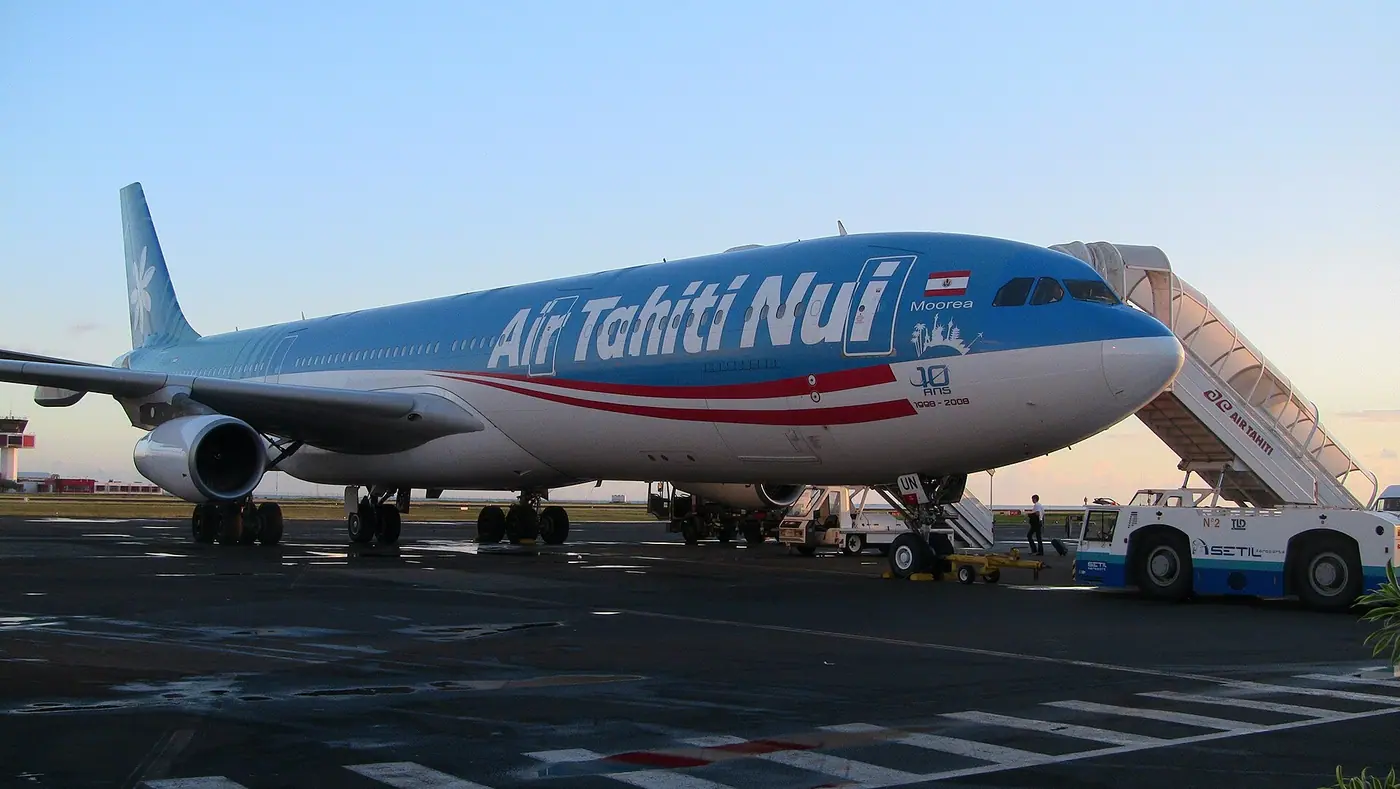
An évacuation sanitaire moves a patient to wherever the required capability exists — another island, or abroad. Inter-island evacuations run at roughly 17 421 patients a year, around a hundred flights a day, costing the system about 2 billion XPF annually. Urgent cases are 10 % of the volume but 33 % of the cost. In 2025 alone there were 587 urgent helicopter evacuations for more than 980 million XPF — roughly 1,67 million XPF, about 14 000 €, each.
For CPS members, all of that is covered at 100 % with direct billing: flights for the patient and an approved escort, all medical costs, approved accommodation, ground transfers. International evacuations — mainly oncology and cardiology — go to metropolitan France or New Zealand.
No official figure exists for the cost of an uncovered international medical evacuation from Tahiti to New Zealand or France. The only numbers in circulation come from private repatriation brokers and have no documentary value. That absence is the point: it is an unbounded liability for anyone travelling without cover.
Prices
Consultation fees in private practice have been unchanged since 1 October 2022: 3 800 XPF (about 32 €) for a general practitioner, 4 600 XPF (about 39 €) for a specialist. That was the first increase in more than twenty years.
The territorial hospital publishes a daily tariff schedule, set by order in 2021 and stated to apply "to all patients whatever their cover". These are the figures a wholly uninsured patient faces.
| Published tariff (2021 schedule) | XPF per day | ≈ EUR |
|---|---|---|
| Medical ward | 285 000 | 2 390 € |
| Paediatrics / neonatology | 365 000 | 3 060 € |
| Surgery, ENT, ophthalmology | 455 000 | 3 810 € |
| Cardiology, haematology, oncology | 530 000 | 4 440 € |
| Intensive care | 820 000 | 6 870 € |
| Psychiatry | 240 000 | 2 010 € |
| Day case, under 12 hours | 48 000 | 400 € |
| Dialysis session | 220 000 | 1 840 € |
Imaging, implants and chemotherapy are billed on top of the daily rate. One caveat worth knowing: the 2014 version of this schedule was ruled unlawful by the administrative court for patients not affiliated to the CPS, as "manifestly overvalued and unrelated to the services provided". It remains the only published schedule.
Visitors
The 2011 order setting out documents required to enter French Polynesia demands a valid travel document and, depending on nationality, a visa. It requires no proof of health insurance and no proof of repatriation cover. Nobody will stop you at the airport for arriving uninsured.
What that means in practice follows directly from the facts above: the EHIC is inoperative; form SE 980-04 covers immediately necessary care only and makes you advance fees in town practice; an uninsured visitor pays the published hospital schedule in full; and no public mechanism repatriates a visitor. A policy for French Polynesia therefore needs to cover, at minimum, hospital costs without a ceiling low enough to matter, inter-island medical evacuation, and international repatriation.
Health risks
An epidemic ran from November 2023 to November 2025: 2 675 cases, 131 hospitalisations, no deaths, serotype DENV-1 in 90 % of samples, across 25 islands. Highest attack rates: Rangiroa, Fakarava, Bora Bora. The country has been in an inter-epidemic period since; the last bulletin available (week 29 of 2026) reported a single probable case.
No circulation reported in the 2025 and 2026 surveillance bulletins. The 2013-14 Zika epidemic here is historically important — it established the link with Guillain-Barré syndrome — but it is not a current risk.
Seasonal, tied to heavy rain, and the one that genuinely puts people in intensive care. Week 4 of 2026: 4 cases, 4 hospitalised, 2 in intensive care. Avoid fresh water after heavy rain if you have open skin.
153 declared cases in 2024, 184 in 2023, no deaths but intensive care admissions. It affects every archipelago; more than a third of the fish involved came from the Tuamotu. Around 29 % of cases came from fish bought in shops or eaten in restaurants — it is not only a risk for people who fish themselves.
There is no malaria in French Polynesia and no antimalarial prophylaxis is needed. The only compulsory vaccination is yellow fever, required for anyone over nine months old arriving after a stay in an endemic country. Hepatitis A, hepatitis B for long or repeated stays, and typhoid for extended stays are recommended, not required.
In an emergency
| Service | Number |
|---|---|
| SAMU — medical emergencies | 15 |
| Police | 17 |
| Fire and rescue | 18 |
| Sea rescue (VHF and telephone) | 16 |
The European 112 is not listed by the High Commission and no official local source confirms that it works here. Use 15, 17, 18 or 16.
Local hospital emergency lines: Moorea (Afareaitu) 40 55 22 26, Raiatea (Uturoa) 40 600 855, Taravao 40 57 76 76. On-call pharmacies at weekends are listed by the pharmacists' council; a prescription must carry the doctor's time stamp to be dispensed out of hours.
Questions people actually ask
No. The EHIC only works within the scope of the EU regulations — the 27 member states, Norway, Iceland, Liechtenstein, Switzerland and the United Kingdom. French Polynesia is an Overseas Country and Territory and falls outside all of them. French insured persons need form SE 980-04 instead, obtained from their own fund before departure.
Not directly. French Polynesia runs its own system. A coordination decree of 26 December 1994 opens a right to immediately necessary care during a temporary stay, on presentation of form SE 980-04. It does not cover planned treatment, repatriation or assistance, and in a town practice you pay first and claim afterwards.
The territorial hospital's published schedule applies to all patients: 285 000 XPF a day in a medical ward, 455 000 XPF in surgery, and 820 000 XPF — about 6 870 € — in intensive care. Imaging, implants and chemotherapy are billed on top.
There is no legal requirement — the entry rules ask for a valid travel document and, depending on nationality, a visa, and nothing about insurance. But no public mechanism repatriates a visitor, the cost of an international medical evacuation is not published anywhere, and inter-island evacuations are routine. That is the exposure a policy covers.
On Tahiti it is a full modern hospital with intensive care, imaging, surgery and radiotherapy, plus two private clinics. Outside Tahiti it thins out fast: 52 beds at Uturoa for the whole Leeward Islands, 25 at Taiohae, 13 on Moorea, and health posts in the atolls. Anything serious in an outer island means an air evacuation to Tahiti.
No malaria. Dengue ran epidemic from November 2023 to November 2025 — 2 675 cases, no deaths — and has been quiet since. Leptospirosis is seasonal and serious. Ciguatera fish poisoning produced 153 declared cases in 2024, and about 29 % of them came from fish bought in shops or eaten in restaurants. Yellow fever vaccination is required only if you arrive from an endemic country.
Check before you rely on this
Affiliation, reimbursement, medical evacuation.
cps.pf ↗Weekly surveillance bulletins, hospitals, health network.
service-public.pf/dsp ↗How the French and Polynesian systems coordinate, and the 980 forms.
cleiss.fr ↗The published hospital tariff schedule.
chpf.pf ↗Confirm your own entitlement, tariffs and reimbursement with the CPS, the provider and your insurer for your exact status. Figures are dated where they are known; where no official figure exists, this page says so rather than estimating.
Schemes, tariffs and epidemiology checked 19 August 2026 · written in Raiatea, French Polynesia.
Continue exploring